




Most national organizations don’t have a precise number for their annual credit card processing exposure. That’s not an accident — it’s a structural blind spot. And it’s costing them.
The problem compounds quietly
Credit card processing fees are not a chapter-level inconvenience. At the national organization level, they are an enterprise financial exposure that accumulates across dozens or hundreds of chapters, each running their own dues collections, event registrations, and member payments through whatever merchant processing happens to be in place.
The math is not complicated. A headquarters collecting $5,000,000 in annual member payments through a standard credit card processor at a 3% per transaction rate is paying approximately $150,000 per year in processing fees most of which could be restructured or eliminated entirely.
The likeliest reason the national headquarters isn’t concerned about this number is that no one knows there a different arrangement is even possible. The assumption is simply that this is the cost of doing business. And because few know another option exists, the problem never gets the attention it deserves.
What Treasury-based payment routing is
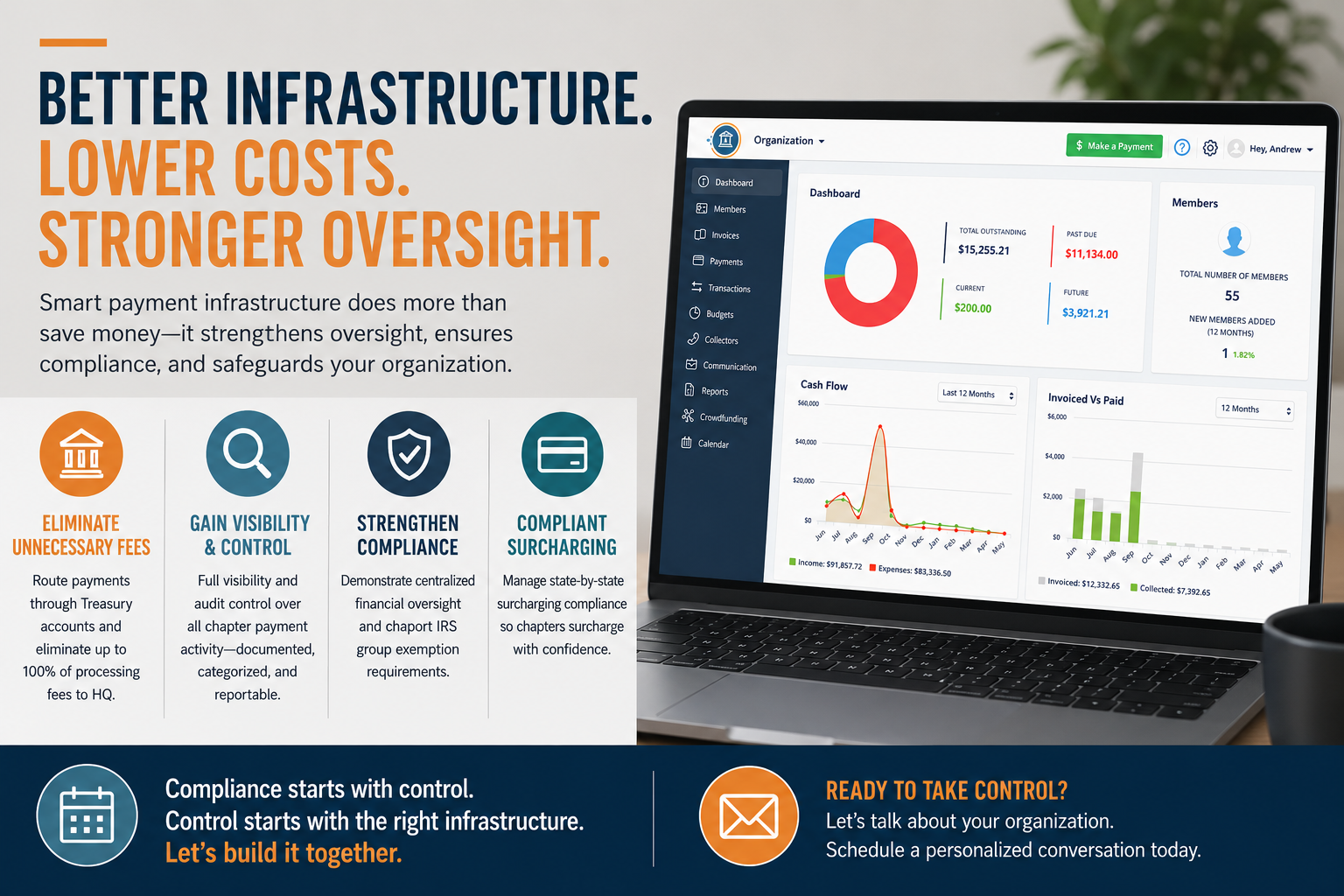
The most effective structural fix for enterprise fee exposure is routing Chapter payments through national Treasury accounts rather than individual chapter merchant accounts. Here is what that means in practice:
• Member payments (dues, event fees, and housing assessments) are collected by the Chapter using LegFi’s prioritized payments (link to blog post about this).
• HQ payments are prioritized first and deposited into a specific Treasury account, when the Chapter pays their headquarters invoices using Treasury accounts instead of credit card or ACH there are no transaction fees.
• The national organization maintains full visibility and audit control over all Chapter payment activity. Every transaction is documented, categorized, and reportable.
• Chapters retain their autonomy over how they set dues and fees. The change is in the infrastructure, not the governance.
One national organization reviewed their costs and learned that moving to LegFi eliminated over $100,000 in annual credit card processing exposure in the first year. The change required no governance restructuring, no new policies, and no chapter-level disruption.
The IRS group exemption connection
There is a second reason to pay attention to payment infrastructure right now, and it goes beyond fee reduction.
The IRS group exemption framework, which allows national Greek-letter organizations to extend tax-exempt status to their chapters without requiring each chapter to file independently, is under increasing scrutiny. Organizations that want to maintain clean group exemption standing need to demonstrate that their chapters are operating in accordance with organizational standards. That includes financial standards.
What does payment infrastructure have to do with group exemption? More than most organizations realize. When chapters are running independently with limited national visibility, the organization cannot easily demonstrate centralized financial oversight. When payment activity is documented, categorized, and routed through a controlled infrastructure, it is.
The organizations that will navigate the next round of IRS group exemption reviews most cleanly are not necessarily the ones with the most complex compliance programs. They are the ones with the most controlled, transparent financial infrastructure. Chapter financial management platforms are a meaningful part of that picture.
The surcharging layer
Fee reduction at the enterprise level through Treasury routing addresses macro-level processing exposure. At the chapter level, a complementary tool is compliant credit card surcharging which is passing some or all of the processing cost to the member paying by card.
This is where it gets complicated, and where organizations get into trouble. Surcharging is legal in most U.S. states, but the rules vary significantly by jurisdiction. Some states prohibit surcharging entirely. Others require specific disclosures. Others cap the surcharge percentage. A chapter in Texas operates under different rules than a chapter in Connecticut.
When chapters implement non-compliant surcharging without guidance, they often get it wrong. The liability for that (fines, chargebacks, and reputational risk) ultimately sits with the Chapter.
LegFi manages surcharging compliance end-to-end. The platform handles state-by-state rule compliance, required disclosures, and percentage caps automatically, so chapters don’t have to interpret regulations on their own, and national organizations don’t have to monitor whether they are.
What this means for your organization
If your organization has not recently conducted a review of its chapter-level payment processing exposure, now is a reasonable time to do so. The questions worth asking are:
• What is our total annual credit card processing cost across all chapters?
• Are any chapters implementing surcharging, and if so, are they doing it correctly?
• Does our national team have visibility into chapter payment activity, or is it siloed at the chapter level?
• What would our financial infrastructure look like to an IRS reviewer examining our group exemption status?
LegFi exists to help membership-based organizations answer these questions and to build the infrastructure that makes the answers good ones. If any of this is resonating, we are easy to reach.
Our team is here to support you! To request surcharging configuration, please contact us at Softwaresupport@omegafi.com.